
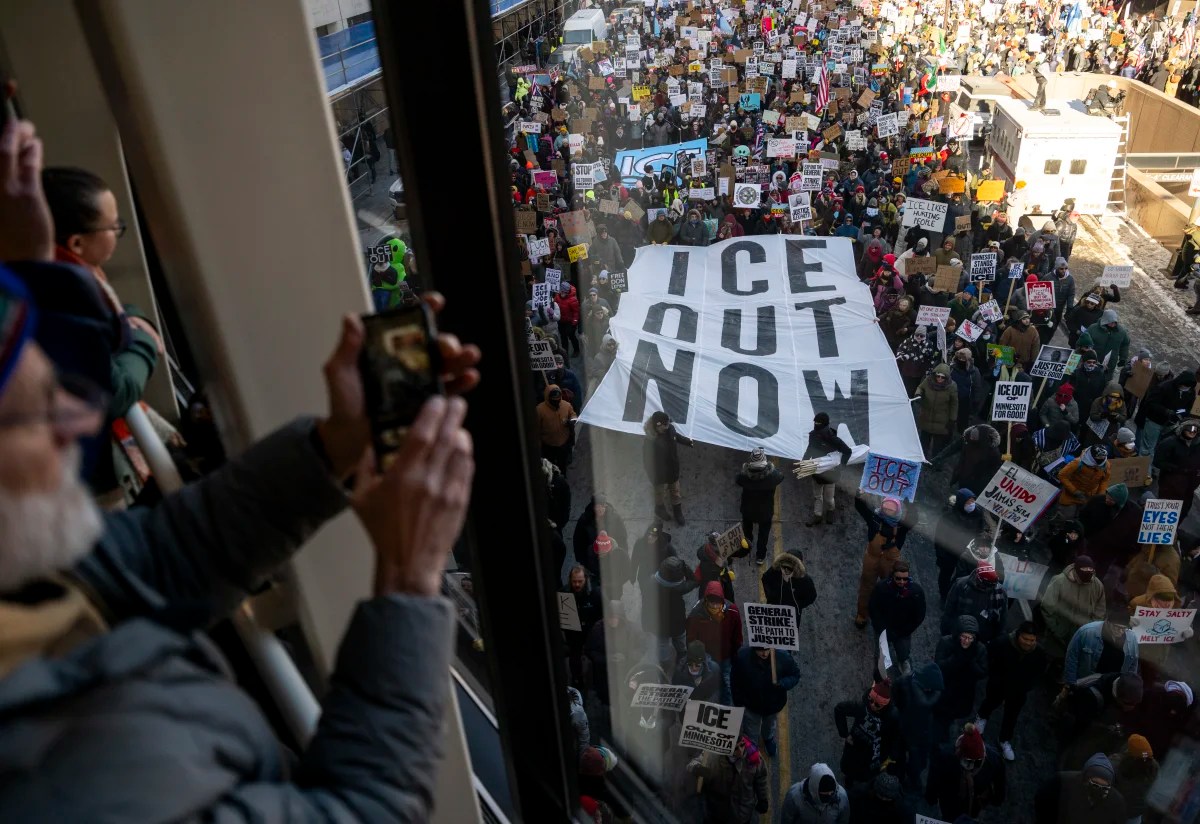
My friend John Velie lives in Minneapolis and part-time in Oaxaca. He tells us graphically how ICE has lately changed its tactics but not its strategy.
ICE doesn’t leave. It’s still here in Minnesota. It’s still here in spite of my Minneapolis neighbors confronting ICE with phone cameras, recording ICE misdeeds, and using whistles and car horns to warn immigrants away from ICE traps set at schoolyards. It’s still here in spite of Good and Pretti being murdered a mile from my home. It’s still here despite the departures of the whore Kristi Noem and the bastard Greg Bovino. It’s still here in spite of me and the thousands and thousands and thousands marching at twenty-four below zero in January through the streets of downtown screaming “fuck ICE, ICE out, fuck ICE, ICE out, fuck ICE, ICE out.” Oh that chant, that rhythm. I felt powerful, we felt powerful. Yet ICE is still here.
They’ve changed their tactics but not their strategy. No more sweeps by thugs in the streets, no more carloads of masked goons in tinted-windowed Chevys departing from the federal building in South Minneapolis to search and terrorize and snatch. ICE is more subtle now, more discrete. They’re mostly done with liberal Minneapolis and St. Paul, but they’re not gone. ICE lurks now in the hallways of rural county courthouses, detaining and disappearing immigrants appearing for court dates. They pump the egos of pro-MAGA rural county sheriffs, convincing these tin-horns to hunt for immigrants by using Flock camera license plate readers. It goes like this: “Spot a car, run the plate. Latino surname? Then contact ICE and we can go get ‘em.”
What makes this even more sick is the sheriffs aren’t looking at Flock cameras in their own counties, but at Flock cameras multiple counties away. Think Mille Lacs County where the sheriff snooped through Flock cameras operated by the City of Fridley police department more than 400 times in one month. Immigrant heavy Fridley is 60 miles south of Mille Lacs County. Nice work, sheriff. I hope you get an ICE pin or something.
Now consider ICE in the city of Appleton, MN (population 1,354) where Core Civic, a private prison company, owned a shuttered prison with room for 1,600 prisoners. Core sold the prison to ICE and the town freaked out. Why? Was it because the good citizens of Appleton were horrified by the thought of this prison becoming a detention center for snatched up immigrants, many (most?) of whom have been living and working in Minnesota for years, paying taxes, running businesses, raising their children? Nope. The good citizens were concerned about a privately held piece of property contributing $800K per year to the local tax rolls becoming a government owned piece of property that wouldn’t have to pay any property taxes. Miraculously, ICE and Core Civic came up with a solution. ICE will pay Core big bucks to run the detention facility and Core will pay Appleton a $1.26 million-dollar fee each year to keep the city happy. I wonder what they’ll call the fee.
John, thanks, great piece by Velie (thanks, John), though the content is so chillingly terrible. It’s worse in the sense that it’s so much less obvious.
In California and elsewhere, communities are resisting for the right reasons. You can read about it here.
Communities and local governments across California are actively resisting the expansion, acquisition, and operation of federal immigration and customs enforcement (ICE) detention facilities. [1, 2]
Grassroots and Community Protests
• Local Opposition: Coalitions like “Ice Out of the Bay” and regional groups stage rallies, legal challenges, and protests against proposed sites, such as a facility planned near Gilroy.
• Direct Action: In locations housing large facilities—like the CoreCivic-operated center in California City or sites in McFarland—detainees have staged hunger strikes, prompting outside solidarity marches led by civil rights figures and advocacy networks demanding facility closures .
• Educational Pushback: School districts and education trustees in regions facing new facility proposals have signed joint letters warning that enforcement footprints induce severe fear, which suppresses student attendance and destabilizes families. [8]
State Legislation and Oversight
• Restrictive Bills: The California Legislature has advanced multiple accountability and anti-expansion measures, including bills to prohibit local governments from approving new private detention spaces or converting existing structures into holding facilities (e.g., SB 1367).
• Forced Transparency: Lawmakers sent measures to the governor’s desk requiring local agencies to publicize 911 and emergency service calls originating from private detention facilities following investigations into safety and abuse allegations (SB 423).
• Federal Workarounds: Because state political resistance prevents ICE from easily partnering with local law enforcement or county jails, federal authorities have resorted to direct multi-billion dollar real estate acquisitions of private facilities (such as Otay Mesa and California City) to bypass local roadblocks . [2, 11]